Summer Safety at the Short-Term Rental: What a Good Host Thinks Through Before the Season Starts
There is a version of this post that opens with a statistic about backyard fire pit injuries, but I am not writing that post. You know the risks exist. What I want to talk about is the posture — that quality of attention a host brings to a property before summer arrives — and then give you the actual language you need for the spaces where things can go wrong.
The host's obligation to a guest's physical safety is one of the oldest obligations in the history of hospitality, embedded in centuries of innkeeper law. The innkeeper was legally responsible for the safety of guests and their belongings in ways that the ordinary householder was not, because the guest was vulnerable — sleeping in an unfamiliar place, without local knowledge, dependent on the host's preparation and judgment. That legal tradition exists because experience taught that guests cannot protect themselves from hazards they don't know to look for.
Your guests arrive at your property not knowing where the patio is uneven, or that the grill runs hot, or that the fire pit throws sparks further than it looks like it should. They don't know the pool depth drops sharply, or that the hot tub jets are stronger than average, or that the path to the fire pit is unlit past a certain point. You know all of this. The asymmetry of that knowledge is where the host's responsibility lies.
I want to show you how I think through summer hazards — not as a liability checklist, but as an extension of the same care that goes into every other aspect of the guest experience. I have also included language you can adapt for your own house manual or house rules, because clear instructions are themselves a form of hospitality. They tell the guest: someone thought about you here.
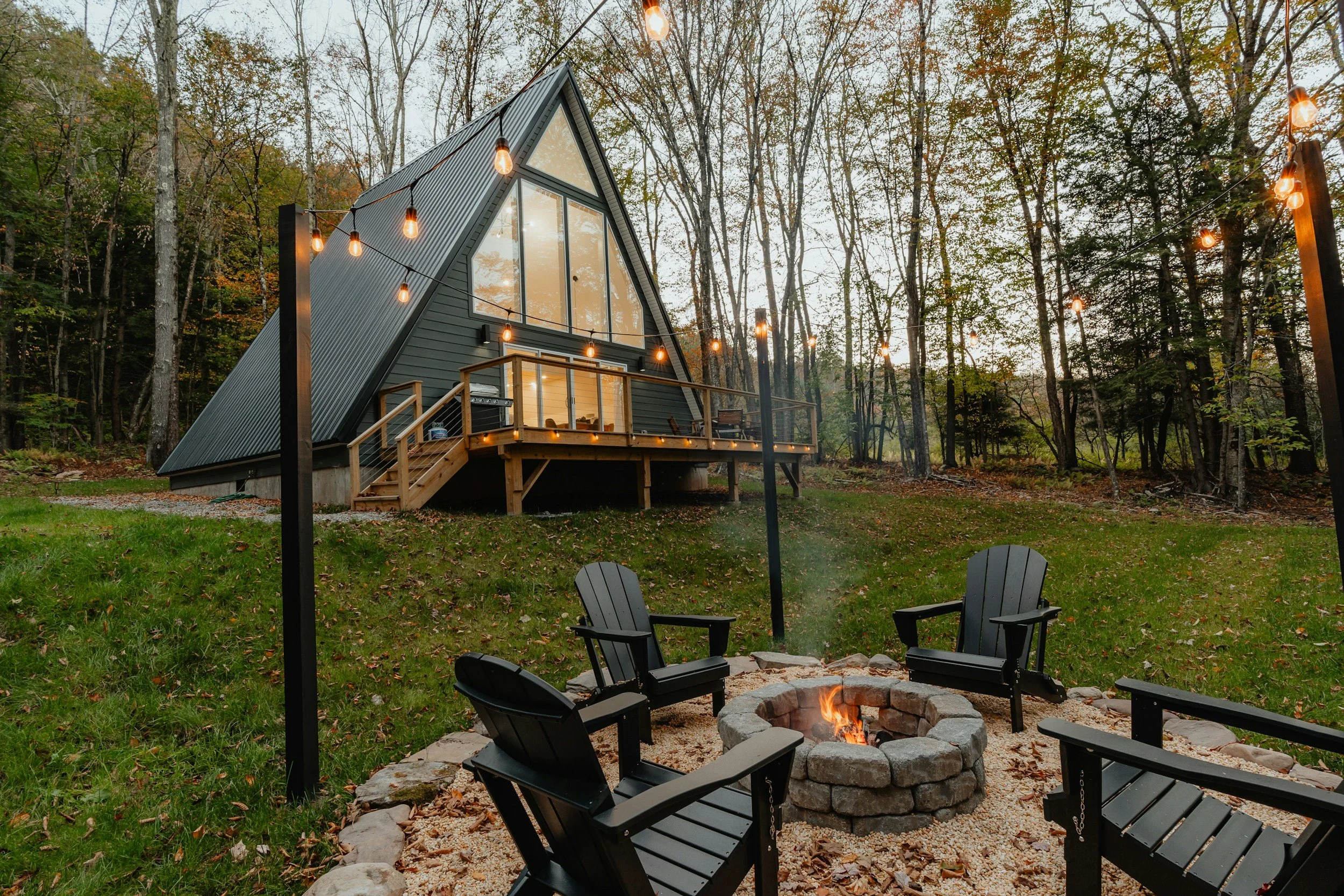
Don’t make fire-pit safety an afterthought.
The fire-pit in beloved, but don't assume your guests have a deep understanding of fire safety.
The Fire Pit
A fire pit is one of the most reliably beloved amenities in a rural or semi-rural rental. Guests plan evenings around it, and remember to bring marshmallows before they pack a toothbrush. The fire pit has a way of dominating the evening, and your guests will be sitting next to an open fire, possibly after a glass (or 3) of wine, possibly with children nearby, possibly without having tended a real fire outside since scout camp.
Your job is not to make the fire pit frightening: It is to make it legible. You give guests enough information that they can use it safely and confidently, just as you're doing with every other element of the space.
Before the season starts, check that the pit is on a stable, non-flammable surface with adequate clearance from structures and overhanging branches. Keep a water source or fire extinguisher nearby and visible. Make sure guests know where it is. Provide a poker and a bucket; don't make guests improvise. If your property is in a drought-prone area or under seasonal burn restrictions, build a check-in process for this — a line in your pre-arrival message that says "check current burn conditions at [link]" is both useful and protective. Even better, check it yourself and tell them— personal involvement is hospitality.
The language below can be copied directly into your house manual, house rules document, or the relevant section of your digital guidebook.
Fire Pit Rules — copy and adapt for your property
Please check current burn conditions and any local burn restrictions before lighting a fire. [Insert link to local resource or county fire information.]
The fire pit is for wood fires only. Do not burn trash, cardboard, treated wood, or accelerants.
Keep the fire contained to the pit. Do not add wood that extends beyond the pit walls.
A water bucket and poker are located [location]. Please use them! (Colored duct tape is helpful here)
Never leave a fire unattended. If you go inside, the fire goes out.
Extinguish the fire completely before going to bed — coals can stay hot for hours. Douse with water, stir, and douse again.
Keep children and pets at a safe distance from the fire at all times.
Do not move the fire pit.
In the event of a fire emergency, call 911. The property address is [address].
The Grill
Grill injuries cluster around a few predictable failures: guests who don't check that the grill is clean before lighting it, guests who use it too close to the structure, guests who leave it unattended, and guests who assume the grill is cold before it actually is. Your instructions should address all four without sounding like a liability waiver.
Grease fires in an unclean grill are the most common issue I hear about from hosting clients. A cleaning protocol at turnover — not just a wipe-down but an actual check of the grease trap — is worth building into your cleaner's checklist if it isn't already.
Grill Rules — copy and adapt for your property
Please inspect the grill before lighting. If it needs cleaning, supplies are located [location].
Keep the grill at least [X] feet from the house, deck railing, and any overhanging surfaces.
Never leave the grill unattended while in use.
The grill surface remains dangerously hot for up to an hour after use. Please treat it accordingly.
Allow the grill to cool completely before covering.
Do not use the grill indoors or in the garage.
Propane tanks are located [location]. If you smell gas, turn off the valve, move away from the grill, and call us before attempting to relight.
Please leave the grill in the condition you found it.
The Hot Tub
Hot tub instructions tendind toward the medically cautionary feel clinical and off-putting — not the register you want in a house manual. The goal is to give guests the information they need without turning the hot tub section into a pharmaceutical disclaimer.
The things that actually matter: temperature (factory-set is usually fine; make clear that guests should not adjust the thermostat beyond a certain point), time limits (especially relevant for guests who've been drinking, are pregnant, or have young children), and the basic maintenance ask — shower before, don't add substances, replace the cover.
Hot Tub Rules — copy and adapt for your property
Please shower before entering the hot tub.
Do not add soaps, oils, bath bombs, or other products to the water.
The water temperature is set to [X]°F. Please do not adjust the thermostat.
Limit soaks to 15-20 minutes, especially in high heat or after alcohol.
Children under [age] are not permitted in the hot tub without direct adult supervision. Children under [age] should not use the hot tub.
Pregnant guests and guests with cardiovascular conditions should consult a physician before use.
Please replace the cover securely after use — this keeps the water clean and the temperature stable.
The hot tub is available between [hours] and [hours] out of consideration for neighbors.
If the water appears cloudy or has an unusual odor, please let us know immediately rather than using it.
The Pool
Pool instructions are the place where hosts most often default to generic legal language, which guests read once and ignore. The goal is language that is clear, specific to your pool, and sounds like it was written by someone who has actually stood next to it.
If your pool has a depth variation, note it. If the steps are slippery, note it. If the pool closes at dusk because there's no lighting, say so plainly. Generic instructions produce generic compliance. Specific instructions produce actual behavior change.
Pool Rules — copy and adapt for your property
No diving. The pool depth is [X] feet at the deep end and [X] feet at the shallow end.
Children must be supervised by an adult at all times. Non-swimmers should wear a flotation device.
Please shower before entering the pool.
No glass near or in the pool— we have provided stylish non-breakable options you’ll find in the cabinent.
The pool is available between [hours] and [hours].
Do not swim alone.
Pool toys and floats are stored [location].
In the event of a pool emergency, call 911. The property address is [address]. A first aid kit is located [location].
The Kayak (and What It Represents)
The kayak is where host liability anxiety tends to peak, and understandably — it involves water, physical exertion, equipment the guest didn't bring and may not know how to use, and a variable natural environment you cannot fully control. It is also one of the amenities guests remember most.
The instinct is to write a long disclaimer. Resist it. What guests need is orientation, not absolution. Where does the kayak launch? What's the water like at different times of day or in different conditions? Where should they not go? What do they do with the equipment when they're done? Answer those questions clearly and you've done most of the work.
The non-negotiable is the life jacket. Make it easy — store the PFDs (personal floatation device) where guests can't miss them, in the sizes they'll actually need, and say plainly in your manual that they're required. If they are clean and tidy, your guest will be far more likely to use them. A guest who leaves the dock without one has made a choice; a guest who didn't know where the life jackets were stored is a different situation entirely, and one that reflects on you.
Kayak Rules — copy and adapt for your property
Life jackets (PFDs) are located [location] and are required for all paddlers. Please select a size that fits snugly.
Children under [age/weight] must wear a Coast Guard-approved PFD at all times on or near the water.
Do not kayak alone. The buddy system is not optional here.
Please check weather and wind conditions before launching. Do not paddle in thunderstorms or high winds.
The launch point is [location]. Please avoid [any hazardous areas — rocks, currents, boat traffic, etc.].
Paddling experience is helpful but not required for [name of body of water]. If you are a beginner, stay close to shore.
Please rinse and return all equipment to [location] after use.
If you encounter difficulty on the water, [emergency protocol — nearest shore point, who to call, etc.].
In the event of an emergency, call 911. The property address is [address].
Other Water and Outdoor Amenities Worth Thinking Through
If your property includes any of the following, each warrants its own short section in your house manual — and its own set of clear, specific instructions. The principle is the same across all of them: guests are in an unfamiliar environment using equipment they may not know well. Your job is to close that gap.
Docks — slippery surfaces, weight limits, rules about jumping or diving, nighttime visibility, whether fishing is permitted and what to do with fish cleaning
Jet skis and motorized watercraft — operator age and license requirements vary by state and should be stated explicitly; speed limits and no-wake zones; fuel and storage protocol
Paddleboards and canoes — similar to kayak rules; note any differences in stability or difficulty
Fishing equipment — licensing requirements (your guests are responsible for their own, but worth noting), catch-and-release expectations if applicable, where to dispose of bait
Saunas — temperature limits, time recommendations, hydration, medical contraindications (same basic territory as the hot tub), rules about water on the rocks, whether outdoor cold plunge or shower access is part of the expected sequence
Cold plunge — temperature, time limits, medical contraindications, the specific caution around cardiovascular stress that makes cold plunge meaningfully different from a hot tub
Hammocks and swings — weight limits are often printed on the hardware and worth repeating; inspection protocol if equipment is older
Bikes — helmet location (and expectation), road conditions guests should know about, what to do if something breaks
ATVs and golf carts — operator age, terrain limitations, helmet or seatbelt requirements, fuel
Outdoor fire features other than fire pits — chimineas, tabletop fires, tiki torches; each has its own hazard profile
The list is not meant to be exhaustive or alarming. It is meant to prompt the question: what does a guest not know about this thing that I know so well I've stopped noticing it? That question, asked honestly, is the whole of summer safety preparation.
A Note on Tone
The lists above are functional by design — they need to be scannable and transferable. But the prose that surrounds them in your manual is where you maintain the register of the rest of your document. A sentence before the fire pit rules that says something like we love having a fire out here and want you to love it too — here's what makes that work does more to ensure compliance than any amount of bold text and asterisks. People follow instructions from people. They skim instructions from documents. For more about this, be sure to check out my post about House Manuals. It’s gold.
The summer amenities are an opportunity, not a liability problem. Handled well, they are the reason a guest leaves a review that mentions the specific evening they sat by the fire, or the morning they had the hot tub to themselves before the mist burned off. That review exists because you thought carefully about the space, built in the right information, and then got out of the way.
That is, more or less, what good hosting has always been.
Which Brings Us to Insurance
All of this — the careful instructions, the well-stocked safety kit, the life jackets in the right sizes — is good hosting practice. It is also, not incidentally, the kind of documentation that matters when something goes wrong.
And things do occasionally go wrong, not because hosts are careless, but because guests are human, and property is unpredictable and the world does not always cooperate. The question of what happens next — financially, legally, practically — is one that Airbnb's standard Host Protection and AirCover language does not fully answer, and that many hosts discover only after they needed to have answered it earlier.
I've written separately about insurance options for short-term rental hosts — what the standard platforms actually cover, where the gaps are, and what dedicated STR policies do differently. If you're adding amenities this summer, or if you've never looked closely at your coverage, that post is worth your time before the season starts.
[Link: What Short-Term Rental Hosts Need to Know About Insurance]