Airing the Guest Room: What Victorian Housekeeping Manuals can teach the Airbnb Host
Somewhere between the invention of the washing machine and the rise of the same-day Airbnb turnover, we lost an idea that the Victorian housekeeping manual considered so fundamental it barely needed stating: that preparing a room for a guest was not a cleaning task but a ritual, and that the difference between those two things was everything.
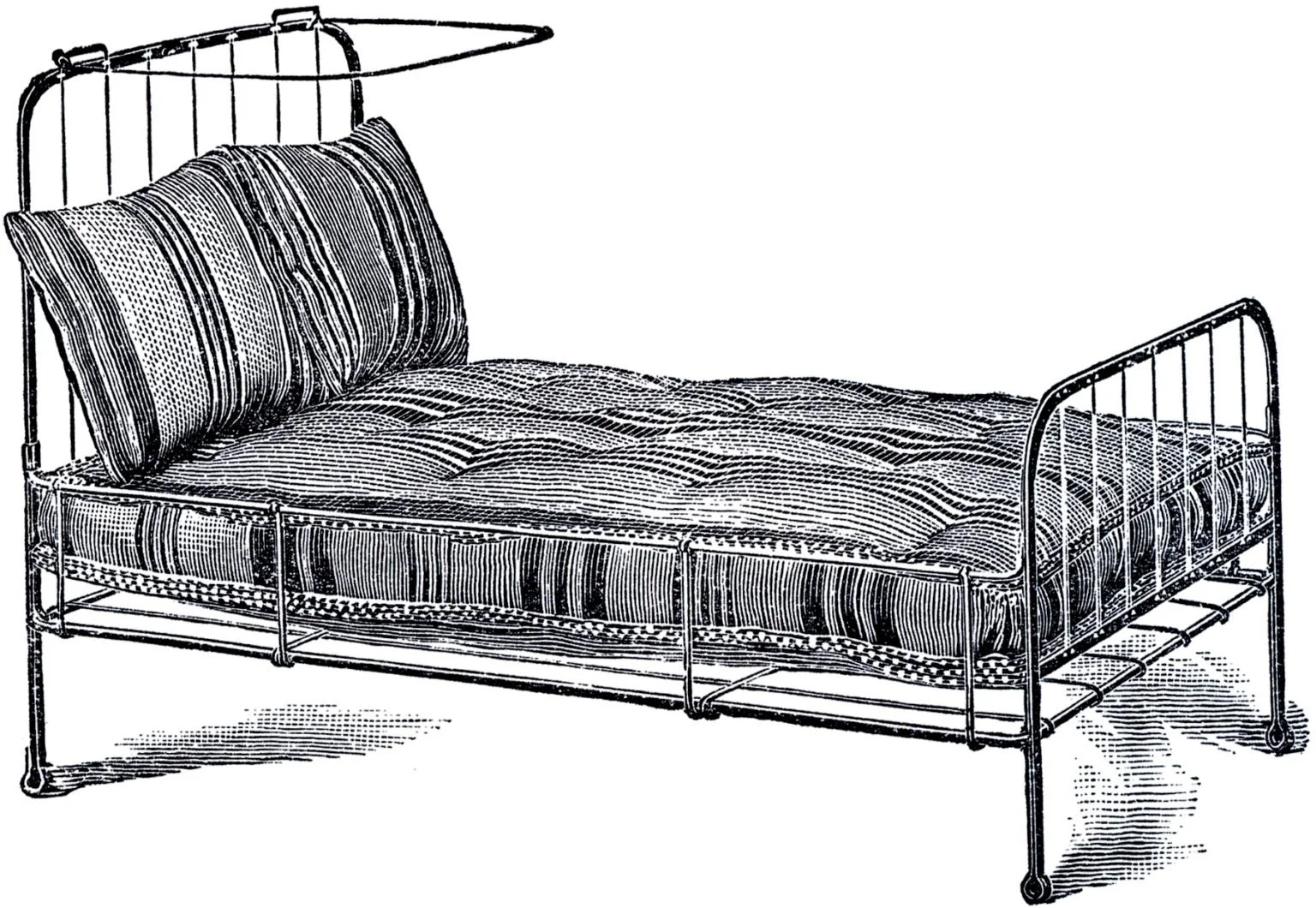
Towards the end of the Victorian period, furniture design began to incorporate the newly discovered science of sanitation.
The cleaning task asks: is it sanitary? The ritual asks: is it ready to receive a person? These questions overlap, but they are not the same question, and the housekeeping manuals of the eighteenth and nineteenth centuries — those dense, magnificent, slightly exhausting volumes that attempted to codify the entire practice of domestic life between two covers — were, at their best, trying to answer the second one. The first was merely prerequisite.
Of all the preparations they described for the guest room, none was treated with more seriousness, more specificity, or more philosophical and social weight than the airing of the bed. And none has been more thoroughly abandoned by the modern host.
The Miasma and the Mattress
To understand why Victorian housekeeping manuals were so insistent about airing — the windows thrown open, the bedclothes stripped back and left to breathe for hours, the mattress turned and beaten, the pillows shaken until the feathers redistributed themselves into something approaching evenness — you have to understand the medical theory that underpinned it, which was wrong in its specifics and remarkably prescient in its instincts, and still use useful and sanitary practice.
Until Louis Pasteur proved germ theory in the 1860s, the dominant explanation for infectious disease was the miasma theory: the idea that illness was caused by bad air, by the accumulated emanations of bodies and rot and enclosed spaces, by what Victorians called "carbonic acid" (carbon dioxide), the particular staleness of a room that had been shut up too long. Housekeepers had a sense that air held contagions (the bestselling American Domestic book, Sarah Hale’s The Good Housekeeper (1839) sideswipes bed curtains as “unhealthy because they confine the air around us as we sleep”), but it was Post-Pasteur that a moral and practical obligation of the well-run household became moving fresh air through every room, every day, carrying away whatever it was that made people sick.
Combatting disease was the domestic priority for the responsible housekeeper– disease rates were shockingly high compared to today. Only two of Louis Pasteur’s five children survived childhood. The stakes of creating a healthy home were high, and the public quickly incorporated Pasteur’s science into their housekeeping practice.
So, by 1869, airflow was the most important American practical domestic responsibility. And Airing a Room was the first step in making it for for human occupation. Catherine Beecher and Harriet Beecher Stowe’s bestselling manual The American Woman’s Home (1869) places their chapter on ventilation as their fourth– just after The Christian Family, A Christian House, and A Healthful Home. Their wonderful book, which is still eminently readable and enjoyable, discusses ventilation in architecture, furniture and linen choice, and modes of living– it is essential for the healthful American family.
The anonymous author of The Housemaid and Her Duties and How to Perform Them (c. 1870) lists some of the practical actions of related to the ritual of preparing the room: the mattress was to be turned every day, the featherbed "well beaten, shaken and turned before it is smoothed," and every bolster and pillow "well shaken too, that the feathers may not get into lumps, and that the whole may be kept thoroughly aired." This was not optional attention, not a nicety — it was, in the manual's framing, the basic standard of a room fit for human occupation.
What the Preparation Actually Looked Like
The preparation of a guest room in a well-run Victorian household was, by modern standards, a substantial undertaking, and the manuals described it with an attention to sequence and detail that suggests both how seriously it was taken and how much could go wrong if the sequence was neglected.
It began, typically, days before the guest's arrival — not hours. The room would be opened, the windows thrown wide, and the bedclothes stripped back to air while the housemaid attended to the rest of the room: the dusting (always from high to low, so that what fell from the shelves could be swept from the floor), the polishing of mirrors and glass until they were free, in the words of The Housemaid and Her Duties, of "fly spots, damp or dust," the laying straight of the bed carpets, the hanging of fresh towels "evenly upon the rail." The grate, if it was cold, would be laid with a fire — not lit, in most accounts, but prepared so that it could be lit quickly; the guest would arrive to a room that was ready to be warm rather than already warm, which was considered the correct hospitality.
Most housekeeping manuals also describe the mistress's morning duties as including the arranging of flowers for the drawing room and dinner table — a daily task, unremarkable enough to be mentioned alongside correspondence and marketing. The implication for the guest room was clear: fresh flowers were not an occasional gesture but a baseline expectation of a properly prepared space, and their absence would have been noticed in the way that a missing towel would be noticed now. Beeton described the daily duties of the well-run household as encompassing not just cleaning but the arrangement of flowers and all the "numberless small duties which are better done early in the day."
The bedstead itself, according to multiple period manuals, was not to be placed against a wall— partly for cleaning access, but partly because the circulation of air around the bed was considered as important as the airing of the bedclothes themselves. The damp that accumulated where a mattress met a wall was, in the miasmatic framework, a genuine threat; in practice, it was simply bad for the mattress and the wall alike, a fact that the modern host who has ever moved a bed away from a wall and discovered what lived behind it will recognize with some feeling.
The Thing They Were Actually Doing
From the distance of a century and a half, we can see that the Victorians were largely right.
The miasma theory was wrong about mechanism — disease is caused by pathogens, not bad air — but the practices it generated were, in many cases, genuinely effective. A mattress that is regularly turned and aired does not accumulate the same concentrations of dust mites and moisture and biological material as one that is not. A room with good airflow does, in fact, harbor fewer of the conditions that allow mold and allergens to flourish. The fresh flowers were not merely decorative; they introduced something living and fragrant into a space that had been closed and static. Fresh flowers also signal that although a guest’s time in the space is brief, it is worth marking and valuing. The fire laid ready, even unlit, meant that the room would reach a comfortable temperature quickly on a cold evening, which has direct implications for sleep quality and the guest's first impression of the house's hospitality.
What the manuals were doing, in their elaborate, codified, occasionally exhausting way, was encoding a set of practices that amounted to taking the guest's bodily experience seriously — not just their comfort in the abstract sense of a clean room, but the specific sensory and physical reality of arriving tired from travel into a space that would either receive them or merely contain them. The airing of the guest room was, at bottom, an act of imagination: the host projecting herself forward into the guest's arrival, asking what that person's body would need, and preparing for it in advance.
This is, it turns out, still the whole job.
What We've Lost and What We Can Recover
The modern short-term rental turnover is perceived, in most cases, as a cleaning task. The checklist is sanitary: fresh linens, clean surfaces, restocked amenities. These things matter and should not be skipped. But they answer the first question — is it sanitary? — without fully addressing the second: is it ready to receive a person?
The airing of the guest room, translated into contemporary practice, does not require a housemaid with a schedule or a featherbed that needs beating. What it requires is a shift in the frame — from the room has been cleaned to the room has been prepared — and a willingness to slow down long enough to ask what the guest's body will actually encounter when they walk through the door.
Open the windows for an hour before the guest arrives, even in winter for a few minutes, and notice what the air in the room becomes. Strip the bed and let the mattress breathe between guests rather than making it up immediately after checkout. Check the pillows — not just the cases, but the pillows themselves — for the flatness and density that accumulates over time and that no guest, in the history of sleeping, has ever found comfortable. Objects picked up to be dusted need to be replaced with care. Consider whether the room smells like a room that has been lived in and refreshed, or like a room that has been cleaned and sealed. These are not the same thing, and guests know the difference before they can articulate it.
The Victorian housekeeping manual, for all its distance from our present circumstances, was trying to answer a question that has not changed: what does it mean to make a place ready for someone you have not yet met, whose needs you are already trying to anticipate, whose experience of your space will begin before you are there to shape it? The answer they arrived at was not a checklist. It was a practice — something you did regularly, with attention, because the person who was coming deserved a room that had been thought about rather than merely processed.
That idea, at least, translates perfectly.
If this way of thinking about hospitality resonates — if you find yourself wanting to approach your space with the kind of intentionality the old manuals were reaching for — I'd love to talk about it. That's the work I do with hosts in my one-on-one mentoring sessions: not the checklist, but the thinking behind it. You can find me and book a free intro call at hostwithelise.com.
Sources and Further Reading
Adams, Samuel, etal. The Complete Servant, 1825.
Beecher, Catharine Esther, and Harriet Beecher Stowe. The American Woman's Home: Or, Principles of Domestic Science. J. B. Ford and Company, 1869.
Beeton, Isabella. Book of Household Management. S.O. Beeton, 1861. Available via Project Gutenberg and Wikisource
Hale, Sarah. The good housekeeper, or the way to live well, and to be well while we live. Containing directions for choosing and preparing food, in regard to health, economy, and taste. Boston, Weeks, Jordan and Company, 1839.
Marshall, Marie Ackley. The Home Guide... Chicago, J. Fairbanks, 1878.
Mendelson, Cheryl. Home Comforts: The Art and Science of Keeping House. New York, Scribner, 1999.
Parloa, Maria. Home economics : a guide to household management including the proper treatment of the materials entering into the construction and furnishing of the house. New York, Century, 1898. Digitized at https://digital.library.cornell.edu/catalog/hearth4217403
The Housemaid: Her Duties and how to perform them. London, Houlston and Sons, 1870. Digitized at https://catalog.hathitrust.org/Record/005295910